



I still remember the first time I wore a dark lip outside the house — not on Halloween, not as a costume, just on a Tuesday. I was nineteen. My hand was shaking a little as I locked the door behind me, like I was committing to something I couldn’t take back. And I think I was. That single coat of near-black plum changed something about how I moved through a room, or maybe it changed how I thought people would see me, which is almost the same thing. That moment keeps coming back to me now, years later, every time I try to explain why goth makeup still matters — why it’s never just makeup.
The Face I Show the World
There’s a particular kind of freedom that comes with committing to a dark aesthetic. Not the freedom people assume — not “not caring what anyone thinks,” because that’s a lie most of us tell ourselves. It’s something quieter. It’s the freedom of coherence. Of walking out the door and feeling like your outside and inside are finally speaking the same language.
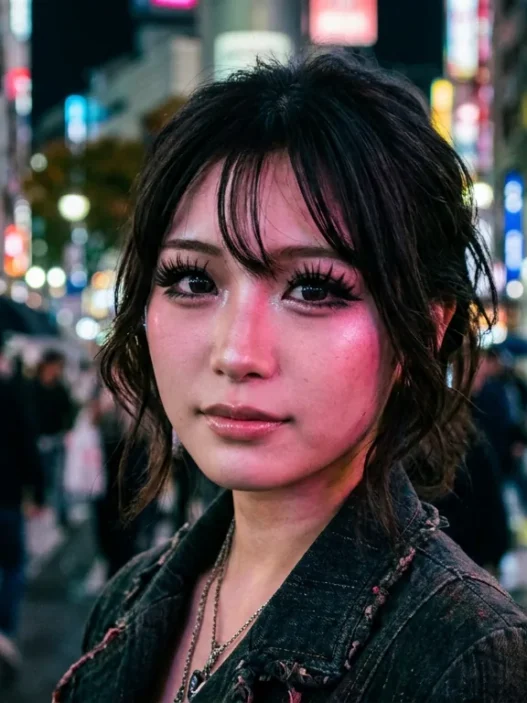
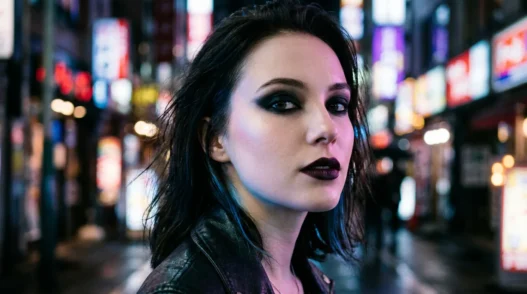
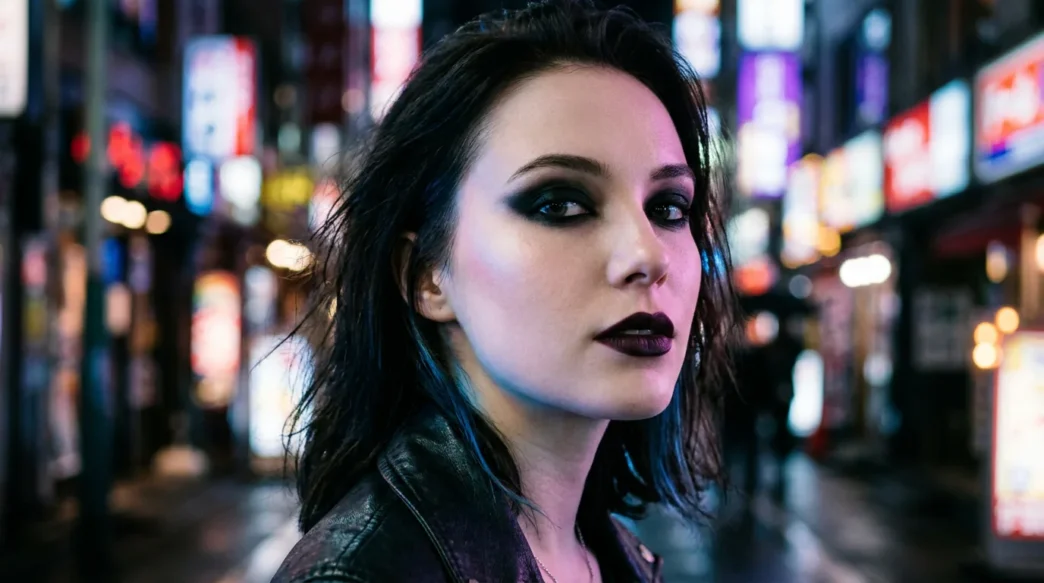
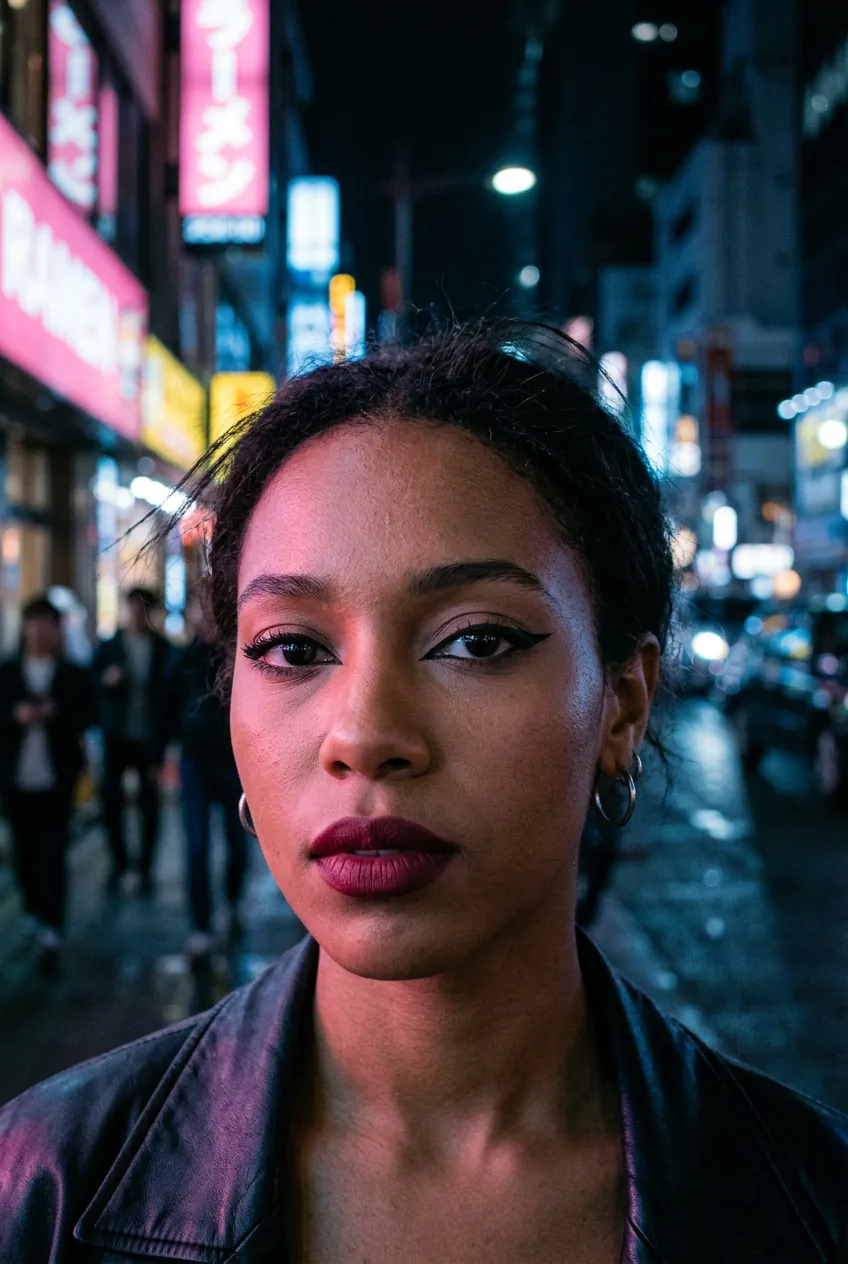
Look at her in this photo — the way the smoky liner bleeds just slightly at the outer corner, the way the deep burgundy lip anchors the whole face against the neon-washed street behind her. That’s not accidental. That’s someone who has made a deliberate decision about how they want to exist in a space. I find that incredibly compelling. There’s intention written all over it.
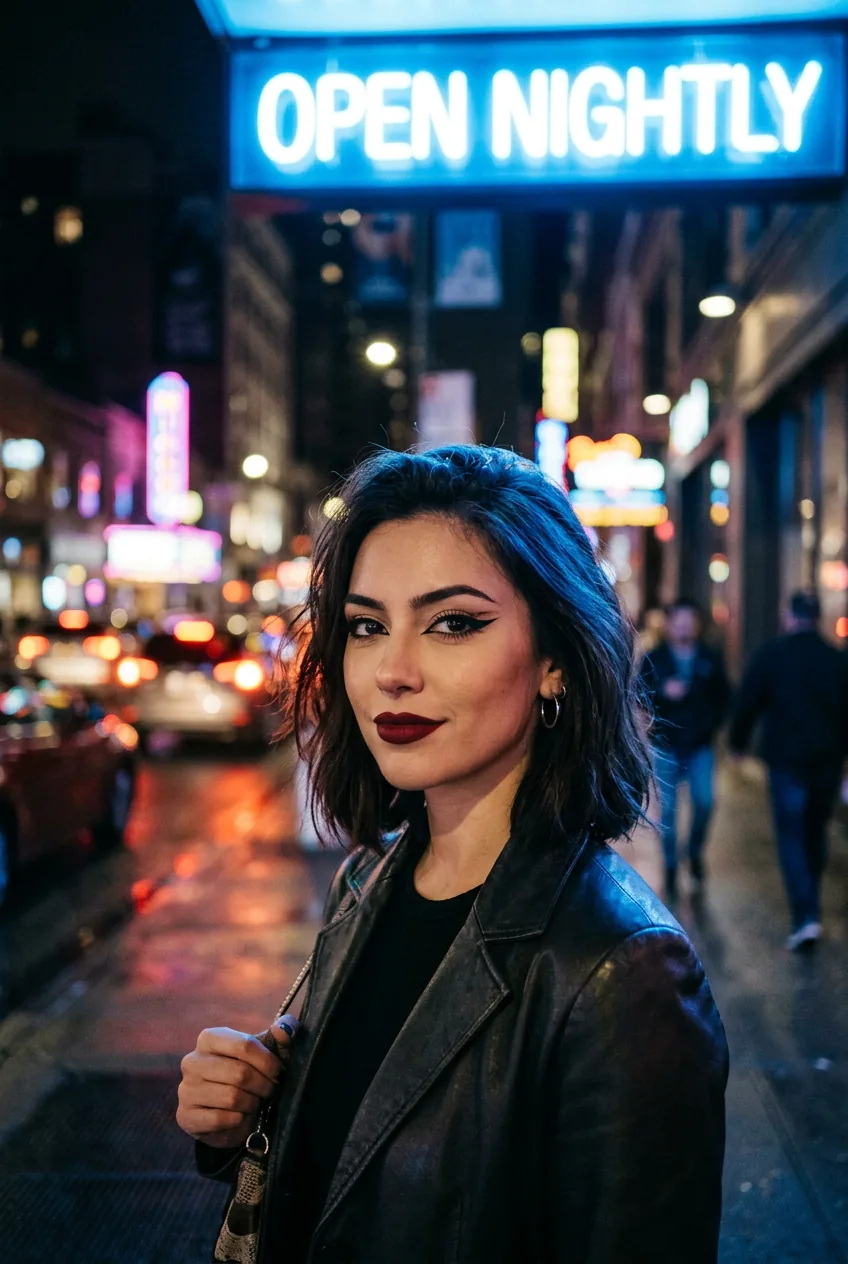
And yet. There’s this thing that happens when you lean into goth makeup — people constantly want to know why. Not in a curious, generous way. In a diagnostic way. Are you sad? Are you angry? Are you trying to be different for the sake of it? The question underneath the question is always: what are you hiding? Which assumes, of course, that a face painted pale with deep-set shadow must be concealing something. The irony is that it might be doing the exact opposite.
I’ve written before about how alt makeup is just basic goth with better PR — the rebranding of dark aesthetics into something more palatable, more Instagrammable, more divorced from the subculture that gave it weight. That rebranding irritates me more than I usually admit. Because something gets lost when the darkness gets sanitized. The whole point was never to be pretty-dark. It was to be honest-dark.
Mask or Mirror?
Here’s the question I’ve been sitting with for years, and I still don’t have a clean answer: is dramatic makeup a mask you put on to protect yourself, or is it a mirror — the truest reflection of who you actually are? And is it possible that it’s both, and that neither of those things is a problem?
I think about the days I’ve worn heavy shadow not because I felt powerful, but because I felt completely hollowed out and needed the armor. That’s mask behavior. But then I think about the days where I’ve sat down at the mirror in the early morning, fully alone, and painted something that made me feel recognized by my own reflection. That’s not armor. That’s excavation.
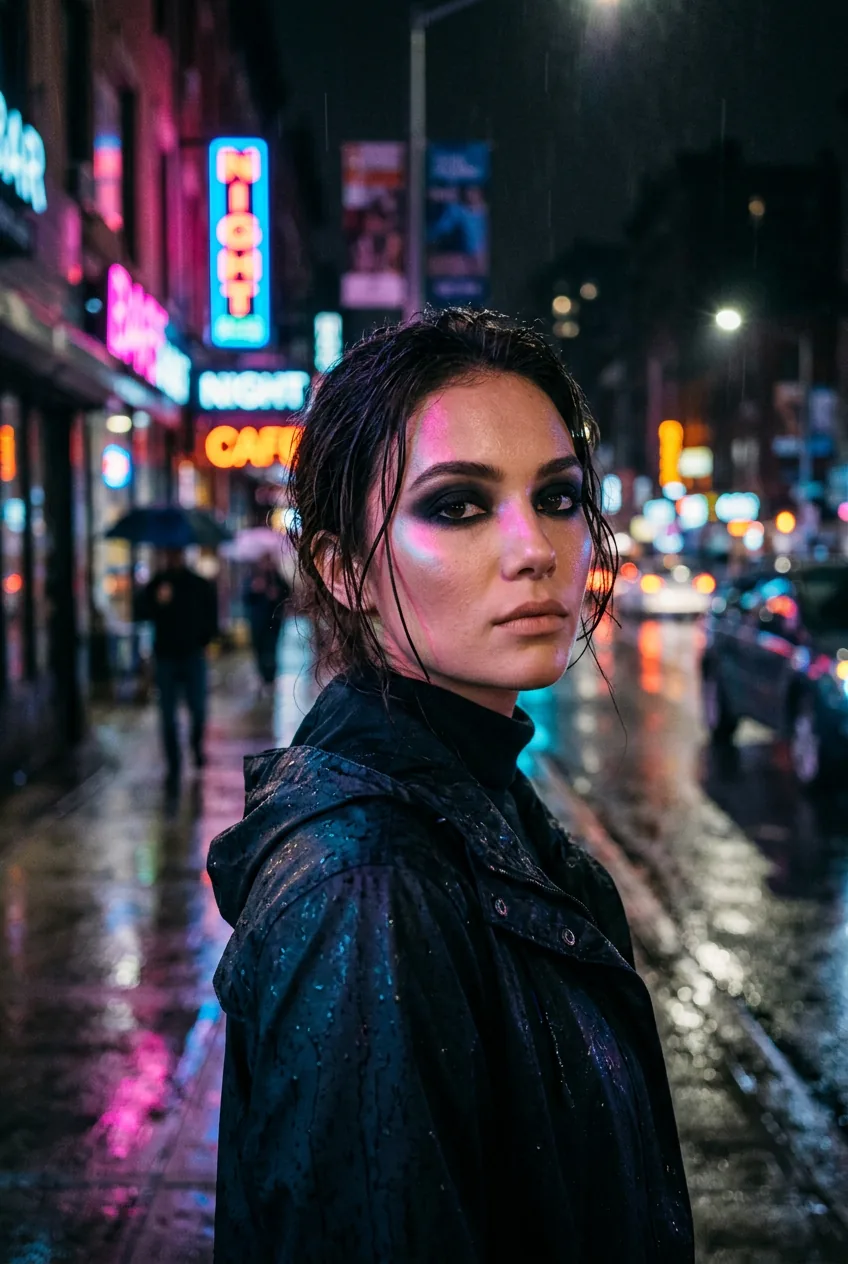
The psychological literature on this is genuinely interesting — researchers have looked at what’s sometimes called what professional MUAs know about dark feminine makeup that the rest of us don’t, and part of it comes down to this: dark, dramatic makeup applied with skill reads as controlled, intentional, and powerful — not chaotic. The associations people have with darkness in makeup are often projections. The person wearing it is rarely experiencing it the way onlookers imagine.
So which is it — mask or mirror? My honest answer is: it starts as a mask and slowly becomes a mirror. You put on the dark lip because you saw someone else wearing it and felt a recognition you couldn’t explain. Then you wear it enough times that it stops feeling like costume. Then one day you catch yourself in a shop window and think — oh, there I am. The mask and the face underneath have merged. That moment is worth everything.
When It Feels Like Me
There are specific combinations that feel so fundamentally mine that I can barely articulate them without sounding like I’m describing a personality rather than a product lineup. Bone-pale base. Eyebrows drawn with a precision that is almost architectural. A liner wing that’s less about flirtation and more about geometry. And then the lips — either the full near-black, or nothing at all. No in-between.
What I find interesting is how monochromatic the effect ends up being. Not in a boring way — the opposite, actually. There’s something about limiting your palette to shadows and near-neutrals that creates a visual intensity that a rainbow eyeshadow look simply can’t. If you’re drawn to this kind of restraint, the world of monochrome makeup goes much deeper than most people realize, and goth aesthetics basically invented it.
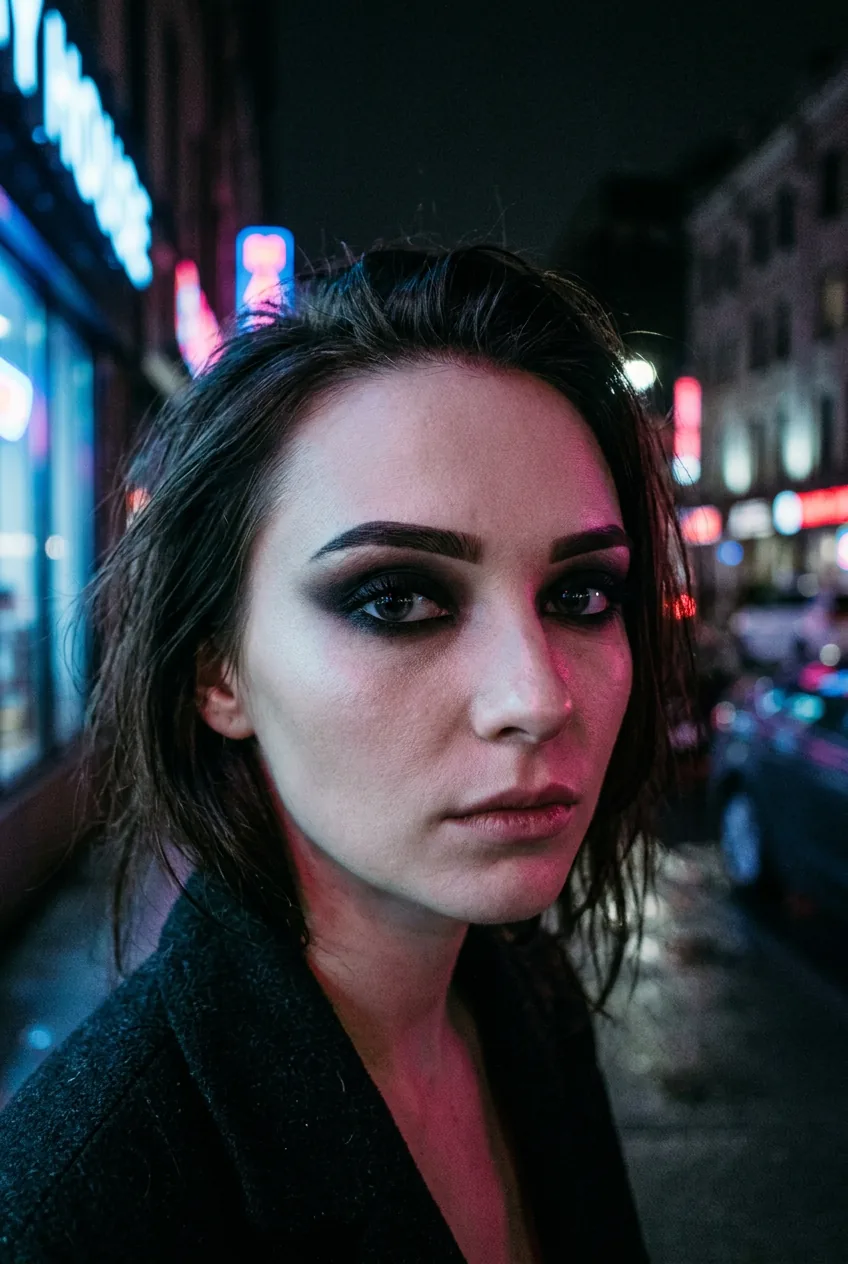
She’s wearing almost no color in this image — look at her. The whole face is built from value contrast, from light against dark, from the way the blueish neon catches the high points of her cheekbones against the deep-set shadows. And it’s arresting. More arresting than if she’d been wearing something loud and colorful. That’s not an accident of the light. That’s what happens when someone understands that goth makeup at its core is about contrast, not color.
There’s also something I want to say here about joy. People assume that wearing dark makeup means you inhabit some permanent emotional minor key. And sometimes, honestly, it correlates. But plenty of mornings I put this face on while dancing to something absolutely ridiculous, feeling genuinely delighted by the whole ritual. The darkness and the joy aren’t opposites. They share the same space in me, and my face reflects both.
What I’ve Made Peace With
Unpopular opinion time: I’ve made peace with the fact that I’m not for everyone, and I’m no longer interested in softening my face to make people more comfortable around me. I spent a chunk of my late twenties periodically toning it down — doing a “cleaner” look for professional contexts, going lighter for family events, making myself more legible to people who found the dark unsettling. And every single time, I felt like I was apologizing for existing.
Legibility for other people’s comfort is not the same thing as authenticity. I kept confusing the two, and it cost me something I’m still reclaiming.
I’ve also made peace with the fact that goth makeup, like all aesthetics that come from subcultures, is not a monolith. There’s the theatrical, the romantic, the industrial, the soft goth, the cyber edge. There are people who came to it through music and people who came to it through fashion history and people who just looked in the mirror one day and saw that deep shadow felt right. All of those paths are legitimate. None of them owe the others an explanation.
What I’ve found harder to make peace with is the trend cycle claiming this aesthetic for a season and then discarding it. Right now we’re in a moment where grunge makeup is suddenly everywhere in 2026 — which on one hand means better product availability and more editorial representation, and on the other hand means it’ll get bored of itself in eighteen months. For people who’ve been wearing this face for years, that boom-and-bust rhythm is exhausting. We were here before. We’ll be here after.
The Deeper Conversation Nobody Starts
Here’s what almost nobody talks about: the way goth and dark feminine makeup has historically had a complicated relationship with fear. Specifically, other people’s fear of it. And specifically the way that fear is gendered.
A man in a dark tailored suit commands a room. A woman with dark lipstick and heavy eye work is asked if she’s okay. The same palette, the same message of power and intentionality, reads completely differently depending on gender. I think about this every time I consider toning something down. I’m not always sure whether I’m exercising restraint or responding to someone else’s discomfort that I’ve internalized so deeply I think it’s mine.
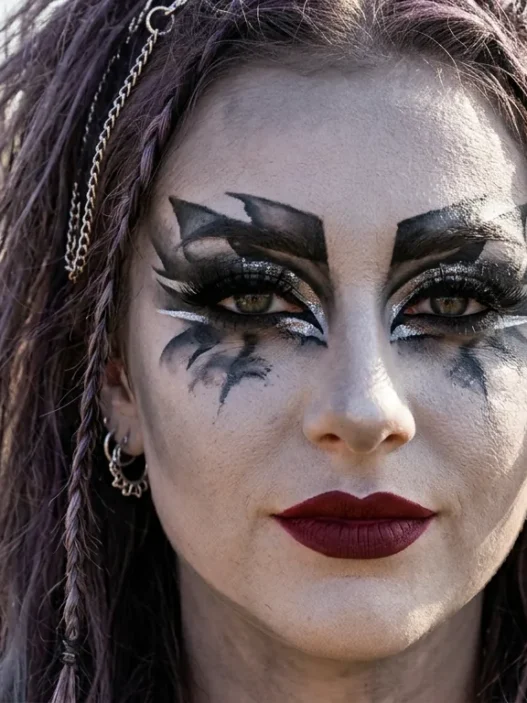
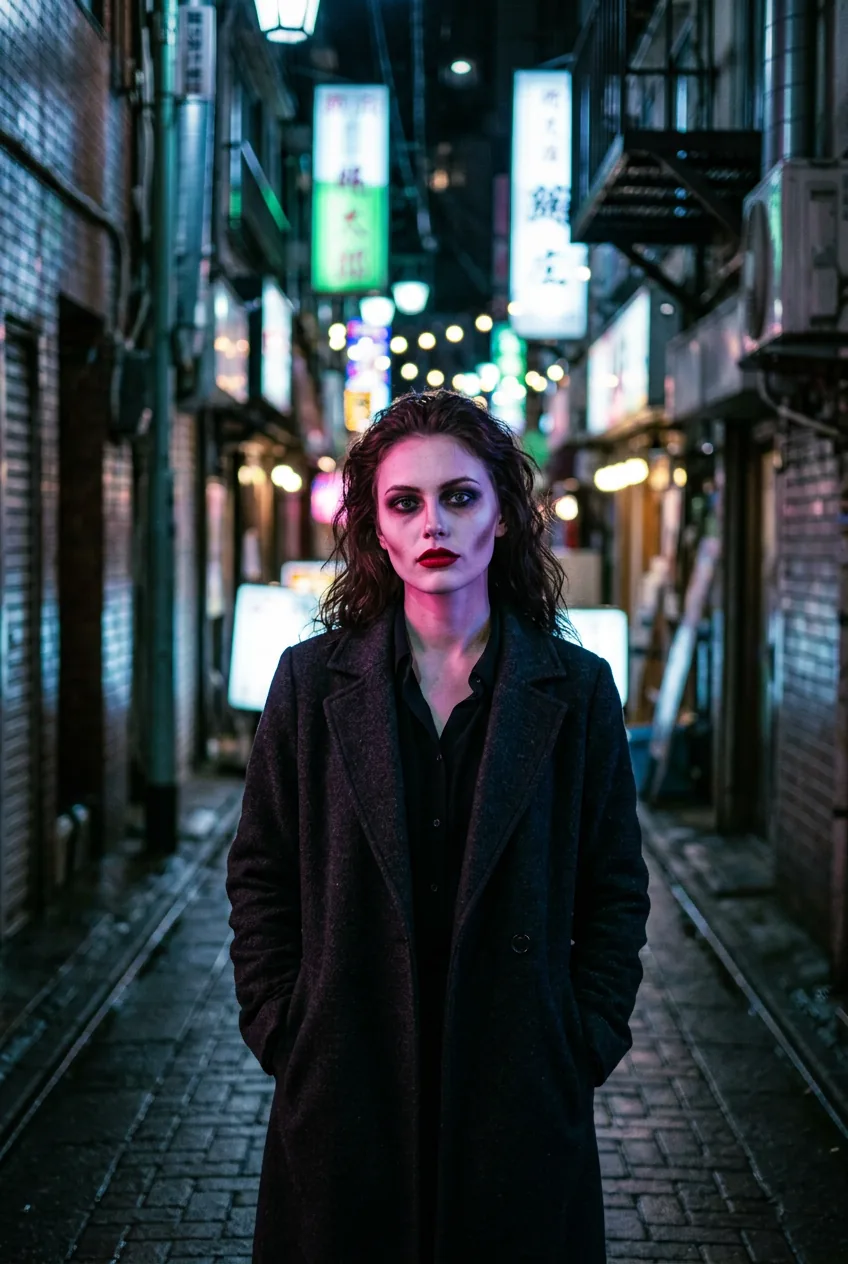
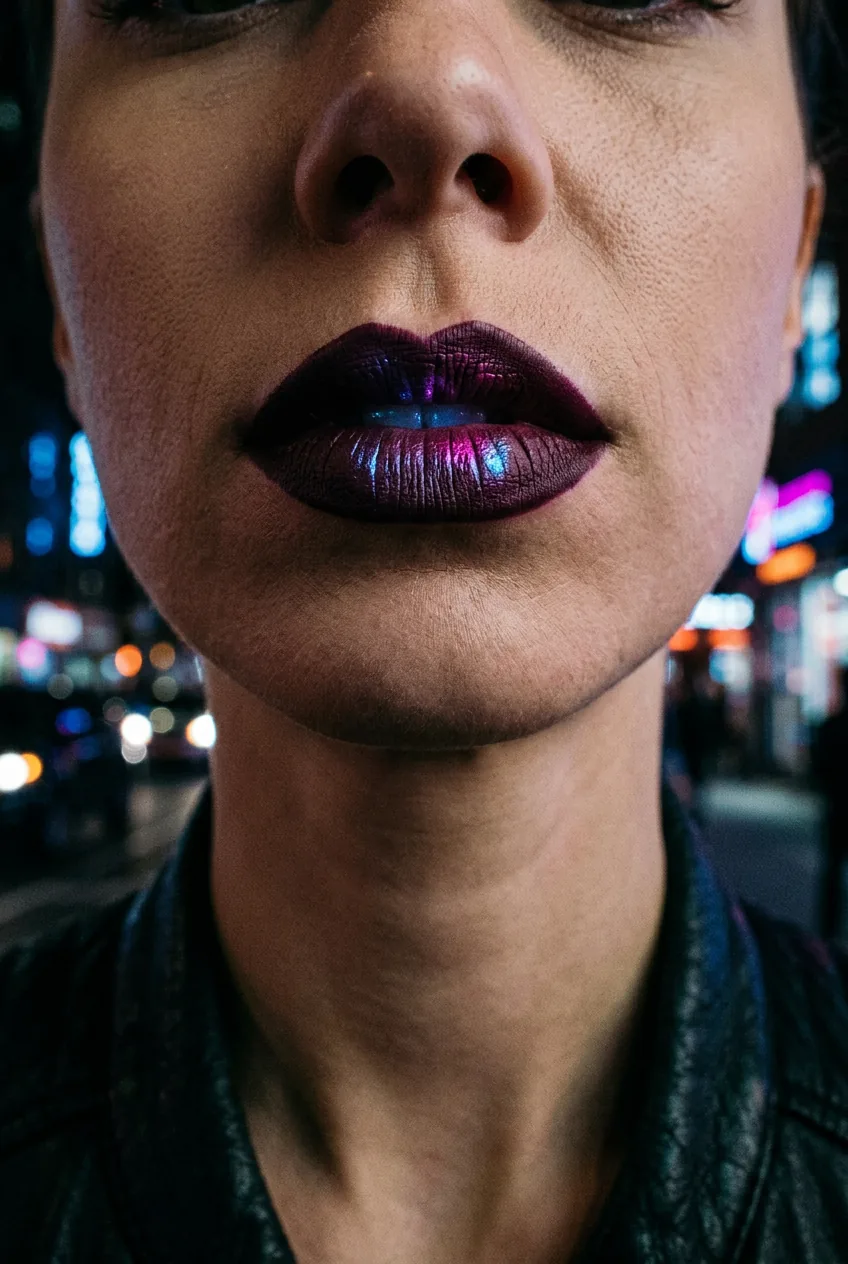
There’s a specific look I resisted for years — more vampiric, more theatrical than my usual daily aesthetic. I kept thinking it was “too much.” Then I finally wore it and realized that “too much” was someone else’s voice living rent-free in my head. What the vampire makeup I resisted for years actually did was crack something open about why I draw any lines at all around my own face.
The face you choose to show the world is a form of speech. And dark, dramatic, goth-inflected makeup has always been a particular kind of speech — one that refuses comfort, refuses smallness, refuses the idea that a woman’s face exists primarily to reassure the people looking at it. That refusal is not a costume. It’s a position. I think that’s why it sticks — why people who find it young tend to come back to it even when they drift away, why it survives every trend cycle that tries to consume it. It means something that a contouring tutorial simply doesn’t.
You can also deepen your understanding of the philosophical and practical side of this through dark eye makeup techniques — the craft side connects to the identity side more than people realize. Knowing why a particular shadow placement creates intensity makes you a more intentional wearer, not just a more skilled one. And intentionality is the whole point of this kind of face.
Some questions worth sitting with — and I mean actually sitting with, not skimming past: goth beauty and identity shapes the context of everything we’re talking about here. What does it mean to borrow an aesthetic without its roots? What do you keep, what do you let evolve? There are no clean answers. But I think asking matters.
Questions I Get About This
Is goth makeup appropriate for professional settings?
That depends heavily on the profession and the culture of your specific workplace — but I’d push back gently on the framing. A well-executed dark lip or precise smoky eye is not inherently unprofessional; the bias is the problem, not the lipstick. That said, I’ve found that a clean, precise application of dark makeup reads as “intentional” and “confident” in most contexts, which tends to carry its own authority.
Can goth makeup suit all skin tones?
Absolutely — and I’d argue it looks extraordinary across a wide range of skin tones in ways that mainstream editorial doesn’t always show. The key is adjusting your palette: deeper skin tones often carry off jewel-toned darks and rich crimsons in ways that feel completely different from the more pallid, grey-toned aesthetics associated with classic goth. The contrast principle works on every complexion — it just expresses differently.
Do I have to commit to the full aesthetic, or can I take just pieces of it?
You can absolutely take pieces — a dark lip with an otherwise minimal face, or a strong liner with neutral skin, is a legitimate choice. But I’ll be honest: there’s a certain coherence that comes when you commit more fully, and that coherence is part of what makes this aesthetic feel like identity rather than just styling. Experiment freely. See what sticks. The face figures itself out gradually.
How do I stop feeling self-conscious about wearing dark makeup in daily life?
You wear it enough times that the novelty of other people’s reactions wears off. The first few times you go out in a full dark look feel loaded. Around the fifteenth or twentieth time, you stop scanning the room for reactions and start just existing in your face. Repetition does something that pep talks can’t. The self-consciousness doesn’t disappear — it just stops having veto power.
I don’t think I’ll ever arrive at a final answer about what my face means or why this particular darkness feels so necessary. And I’ve stopped needing one. The face I choose in the morning is not a conclusion — it’s a practice. Some days it’s armor. Some days it’s excavation. Most days it’s just the truest thing I know how to say before I’ve said a single word. That’s enough reason to keep saying it.